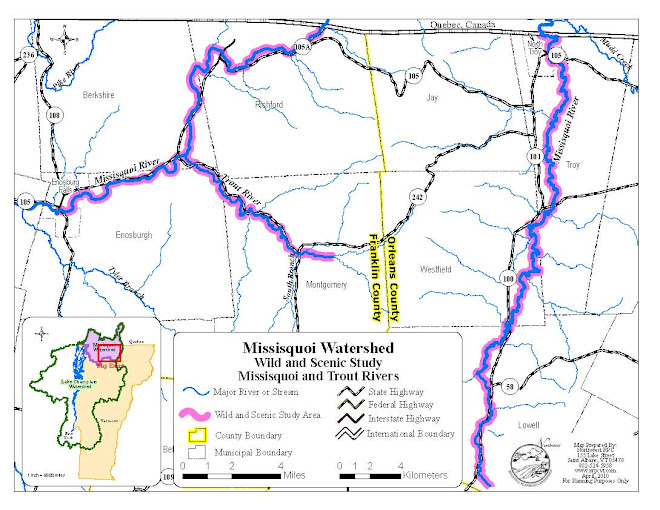
A congressionally authorized study to determine whether a particular river is eligible and suitable for designation as a National Wild and Scenic River under the Wild and Scenic Rivers Act which was enacted by Congress in 1968. The process is entirely voluntary and in the hands of the local community members who are members of the Study Committee. The National Park Service serves as a resource during the study.
Wednesday, July 20, 2011

Monday, July 18, 2011
What is a Wild and Scenic River Study Committee?
This Study Committee includes members from each of the ten towns and villages in the study area: Berkshire, Town of Enosburgh, Village of Enosburg Falls, Jay, Lowell, Montgomery, Village of North Troy, Richford, Westfield, and the Town of Troy. The official appointees were appointed by the town Selectboards. There are also partner organizations on the Committee including: the Vermont Agency of Agriculture, the National Park Service, and the Northwest Regional Planning Commission. The mission of the committee is to gather information about resources along the rivers, protections which currently exist for these resources, and information about whether the local community understands and supports designation.
Is there a Committee established after designation?
If designation occurs a permanent committee will be established to manage the federal funds that typically result from designation. I believe it will be formed similarly to the current committee where towns along the designated reach appoint members to the committee. Either the National Park Service hires or designates a staff person to assist the committee and manage the river, or staff could also be hired through a partner organization such as the MRBA (as has occurred with staff for the Study – Shana). An example of how this occurred for the Lamprey River in New Hampshire can be found at: http://www.rivers.gov/publications/act/104-333.pdf (see Sec. 405).
What are the potential positive effects of designation?
- If designated, Congress would appropriate funds for projects to preserve the recreational, scenic, historic, cultural, natural, and geologic resources in the upper Missisquoi and Trout Rivers. These funds have been over $100,000 annually.
- Landowners would still be the stewards of their lands.
- If attracting tourists is a goal, designation could be a great marketing tool for local businesses and regions supporting ecotourism. For example, there could be a check off list developed of New England’s Wild and Scenic Rivers, akin to those for the high peaks or birding destinations
- Applications for grants may be more competitive in the areas designated Wild & Scenic.
- A local Advisory Committee would be established to oversee the designation funds, and provide outreach for the recommendations in the Management Plan.
- This Committee would have input during the review of projects (Section 7 Review) which are fully or partially federally funded, construction/development, and having a direct impact on the river. These types of projects would be reviewed even without designation, but designation provides more local input into the permitting of these projects.
- The Wild and Scenic Act was created at a time of large-scale dam building. In an effort to balance dammed rivers with those which were free-flowing, there is a stipulation in the Act which prevents the establishment of new dams or hydro facilities on the designated portion of the river. This does not affect pre-existing, permitted hydro facilities such as those in Troy and Lowell. It also does not prevent existing dams from being retrofitted for purposes other than hydro.
Does Wild and Scenic Designation create a 1/4 mile protected corridor along the river?
It is probably more accurate to say that designation “establishes a flexible boundary on both sides of the river.” However, even this is subject to misinterpretation.
What the Wild and Scenic Rivers Act (WSRA) actually says in Section 3(b) is:
“The agency charged with the administration of each…wild and scenic river…shall…establish detailed boundaries…which…shall include an average of not more than 320 acres of land per mile measured from the ordinary high water mark on both sides of the river…”
(The complete act may be found at: http://www.rivers.gov/publications/act/current-act.pdf)
Jim McCartney - National Park Service
Important points to keep in mind:
- That works out to ¼ mile on each side of the river, but does not set ¼ mile as the boundary.
- The flexible nature of the boundary is intended to enable the Study Committee to capture most or all of the Outstandingly Remarkable Values (ORVs) within the boundary by varying its width as need be. See our ORV blog http://vtorvs.blogspot.com/ or our website (http://www.vtwsr.org/) to find out more about ORVs.
- On rivers where there is existing federal ownership—i.e. a national forest—it clarifies which lands are subject to the WSRA and which are not. For rivers where Congress has authorized federal land acquisition to implement the designation, the boundary established under Section 3(b) identifies which lands can be acquired, i.e. those within the boundary—see Section 6(a). The upper Missisquoi and Trout Wild and Scenic rivers would be partnership rivers in private, not federal, ownership.
- For most—if not all—partnership rivers, Congress has expressly PROHIBITED the administering agency from acquiring federally owned land.
Even more importantly is how the boundary gets used once established in the management plan by the Study Committee—which is limited to Section 7 determinations and thus only applies to the construction of federally assisted water resources projects. Even then, the application of the boundary is simply to determine which standard the administering agency must use in evaluating the potential effect of the project on the rivers resources.
Jim McCartney - National Park Service
A member of a Westfield Selectboard asked if there was a specific buffer requirement in which there was Wild and Scenic protection.
If the Study Committee pursues designation, then they will establish boundaries for the designated area. There is not a set rule for the size of the border along the designated river. The flexible nature of the boundary is intended to enable the Study Committee to capture most or all of the Outstandingly Remarkable Values (ORVs) within the boundary by varying its width as need be. Having a boundary will not mean that the area is then controlled by the federal government. Regulations which currently govern land use will still be in effect. Please see the previous post entitled “Does Wild and Scenic Designation create a 1/4 mile protected corridor along the river?” for more information.
Ed states: There was talk of possibly including feeder streams in the designation. With this in mind, is there a "zone" or a specific distance from the center of the river the W&S designation would effect?
NPS Staff response: We are looking broadly right now at resources that are in some way related to the river. The time to narrow things down will be after we collect information about the rivers' resources at the end of the study - all tributaries to the Missisquoi and Trout Rivers are currently considered during the study. If our ORV work indicates that there are tributaries that have exceptional value and importance, the Study Committee could consider recommending that they be included in designation (subject to local support). In terms of deliniating a specific “zone” of influence along the river, we will have to wait and see what our management recommendations are, although we already know for sure that there is no “zone” of new federal land use restriction.
Subscribe to:
Posts (Atom)