Jamie Fosburgh, National Park Service (NPS), outlined the Section 7 process as it relates to a designated Wild and Scenic River. He passed out a list of bridge projects the park service has dealt with on designated Wild and Scenic rivers. Based on the input from the Study Committee, he anticipates that the covered bridges within the study area would be identified as an outstandingly remarkable value (ORV) and gave examples of the types of issues that have come up on other designated rivers. He noted that the authority to review under Section 7 exists during the study period, not just once or if the river is designated.
Sunday, February 12, 2012

Focus on bridge projects – the range of Committee/NPS involvement and discussion bridge projects in designated rivers
Discussion of the Montgomery Covered Bridges as an example, with special guest Richard Tetreault from VTrans
Richard Tetreault is the Director of Program Development at VTrans. He explained that when appropriate, VTrans aims to rehabilitate or restore covered bridges instead of replacing them with a metal structure. He noted that there is a historic preservation officer at the agency and he pointed out examples of covered bridges that have been rehabilitated by VTrans. Rich explained that there is a landscape architect on staff to deal with the issues of replanting trees/vegetation after a bridge or roadway project. VTrans has also developed alternative state design standards so the state has more flexibility to design projects so you do not have to default to the federal standards that may not be appropriate for the rural context. VTrans reached out to Oregon and New Hampshire DOTs to get their experience with Wild and Scenic process. VTrans reviewed the regulations and did not see anything of concern. He noted that there were “no show stoppers” for VTrans. Rich suggested the committee contact John Narowski from the Environmental Section of VTrans.
Monday, December 12, 2011
Upper Missisquoi and Trout Rivers Management plan to be completed in 2012
One of the study committee’s responsibilities in applying for federal Wild & Scenic designation is the creation of a management plan for the study rivers. The management plan provides relevant background information on the designation process, describes the key features of the rivers (called Outstandingly Remarkable Values, or ORVs) that qualify them for Wild & Scenic designation, and outlines the priorities for management of the river and its ORVs if designation is achieved. The basic structure of the management plan was discussed and agreed upon by the study committee at the November 17th, 2011 meeting in Richford, VT. Please review the draft table of contents of the management plan; feel free to comment here or contact us about the plan structure or content. You may view the draft plan outline here.
Wednesday, July 20, 2011
What is a Wild and Scenic River Study?
A congressionally authorized study to determine whether a particular river is eligible and suitable for designation as a National Wild and Scenic River under the Wild and Scenic Rivers Act which was enacted by Congress in 1968. The process is entirely voluntary and in the hands of the local community members who are members of the Study Committee. The National Park Service serves as a resource during the study.
Monday, July 18, 2011
What is a Wild and Scenic River Study Committee?
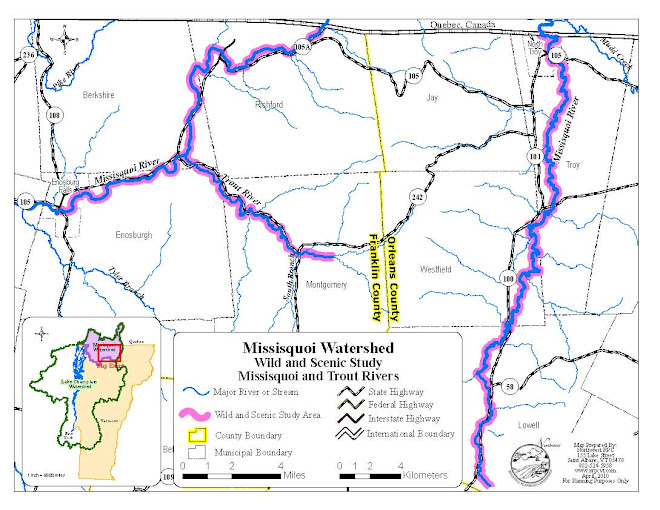
This Study Committee includes members from each of the ten towns and villages in the study area: Berkshire, Town of Enosburgh, Village of Enosburg Falls, Jay, Lowell, Montgomery, Village of North Troy, Richford, Westfield, and the Town of Troy. The official appointees were appointed by the town Selectboards. There are also partner organizations on the Committee including: the Vermont Agency of Agriculture, the National Park Service, and the Northwest Regional Planning Commission. The mission of the committee is to gather information about resources along the rivers, protections which currently exist for these resources, and information about whether the local community understands and supports designation.
Is there a Committee established after designation?
If designation occurs a permanent committee will be established to manage the federal funds that typically result from designation. I believe it will be formed similarly to the current committee where towns along the designated reach appoint members to the committee. Either the National Park Service hires or designates a staff person to assist the committee and manage the river, or staff could also be hired through a partner organization such as the MRBA (as has occurred with staff for the Study – Shana). An example of how this occurred for the Lamprey River in New Hampshire can be found at: http://www.rivers.gov/publications/act/104-333.pdf (see Sec. 405).
What are the potential positive effects of designation?
- If designated, Congress would appropriate funds for projects to preserve the recreational, scenic, historic, cultural, natural, and geologic resources in the upper Missisquoi and Trout Rivers. These funds have been over $100,000 annually.
- Landowners would still be the stewards of their lands.
- If attracting tourists is a goal, designation could be a great marketing tool for local businesses and regions supporting ecotourism. For example, there could be a check off list developed of New England’s Wild and Scenic Rivers, akin to those for the high peaks or birding destinations
- Applications for grants may be more competitive in the areas designated Wild & Scenic.
- A local Advisory Committee would be established to oversee the designation funds, and provide outreach for the recommendations in the Management Plan.
- This Committee would have input during the review of projects (Section 7 Review) which are fully or partially federally funded, construction/development, and having a direct impact on the river. These types of projects would be reviewed even without designation, but designation provides more local input into the permitting of these projects.
- The Wild and Scenic Act was created at a time of large-scale dam building. In an effort to balance dammed rivers with those which were free-flowing, there is a stipulation in the Act which prevents the establishment of new dams or hydro facilities on the designated portion of the river. This does not affect pre-existing, permitted hydro facilities such as those in Troy and Lowell. It also does not prevent existing dams from being retrofitted for purposes other than hydro.
Subscribe to:
Posts (Atom)